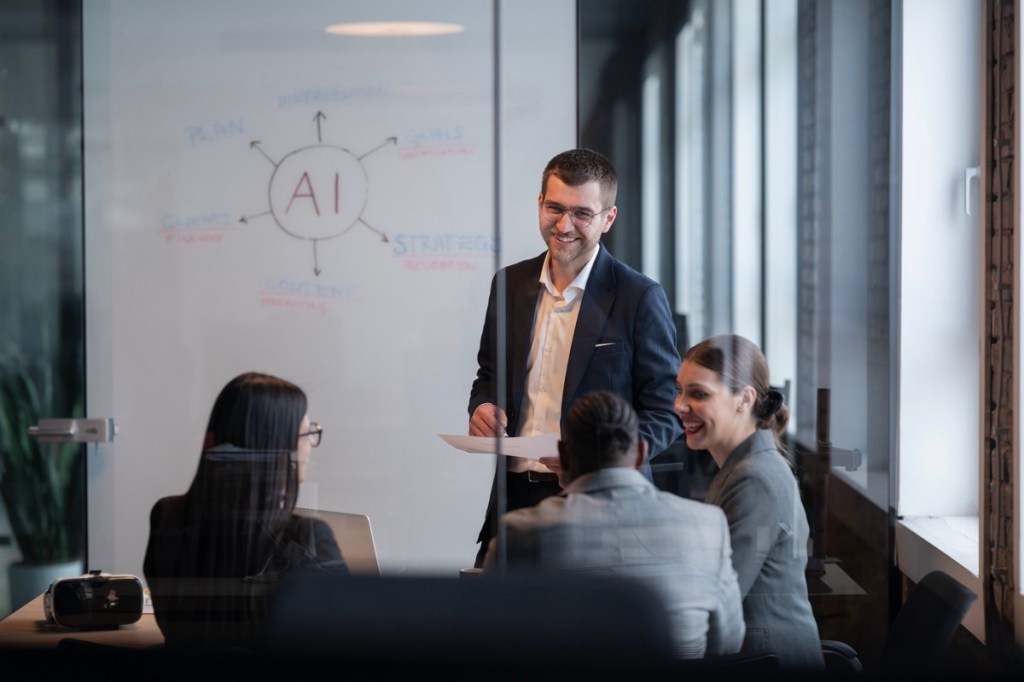
There is no doubt that Artificial Intelligence has enormous potential for transforming the way we work and live yet it is still real people who make the change happen. That thought stayed with me after reading Marie Myers’ recent essay for the World Economic Forum Annual Meeting “Why change management and human oversight are non negotiable when leading through AI.”
From telex to APIs
I’ve spent four decades leading change, and I think Marie Myers is right when she writes, “technology doesn’t transform a company. People do.”
My own journey started in 1988 in the commercial department of the French Consulate in Barcelona, where most work was still done with pen and paper, and communication meant printed letters and calls on a landline.
We had a telex for messages from the Foreign Office in Paris and shared a couple of “personal computers” across a floor of six commercial advisers – closer to advanced typewriters than to today’s laptops. Over the years, I watched the emergence of spreadsheets and databases, then the emergence of internet and emails, the release of accounting software followed by ERPs, the replacement of landlines by mobile phones, the expansion of APIs and cloud computing. I noticed how each latest technology wave reshaped how finance functions run and how CFOs see the world they are helping to steer.
Change is always lead by people
In each organisation where I sat at the CFO desk, technology programmes were presented as opportunities to change the way we work and improve productivity. Success depended on the quality of the new system and its implementation, and more importantly on stakeholder communication and bringing people at every level with us.
Looking back, every major implementation I took part of was less like an IT project and more like a test of leadership, clarity on objectives, quality assurance, and employees’ trust in the new ways of working. That is why Marie Myers’ comments on AI‑first programme failures, and her focus on change management, human engagement and continuous learning in AI adoption, felt so familiar. It was like a modern echo of the structured change principles I used such as PRINCE2 in the late 2000s.
The uncomfortable speed of AI
What is different with AI is how quickly the change is happening. ChatGPT launched to the public in late 2022 and became one of the fastest-adopted consumer technologies in history, with 100 million active users within two months. As of early 2026, there are about 800 million people use it in a given week corresponding to several billion monthly visits to ChatGPT platforms globally.
The Stanford AI Index reports that the compute used to train leading AI models has been growing exponentially, with training compute for notable models doubling roughly every few months and the cost of running ChatGPT‑3.5‑level systems falling more than 280‑fold between late 2022 and late 2024.
McKinsey estimates that generative AI could add between 0.5 and 3.4 percentage points to annual global productivity growth through 2040 when combined with other automation technologies. This is equivalent to trillions of dollars a year!
These numbers point to an extraordinary acceleration, but they also hint at pressure: every month AI systems are becoming more capable, cheaper and progressively more widely deployed far faster than most human learning and organisational cultures can adapt. For finance professionals and many employees, this is likely to feel less like an opportunity and more like an increasingly difficult demand to keep up.
The risk of technical success and human cost
I led multiple change programmes and we always included a significant budget for helping our colleagues to adapt to the change. With AI it looks like there is a magic thinking that employees with become proficient only by using the technology. I am wondering how many companies will allocate enough money in training, coaching and supporting their employees to embrace the new technology and change their way of working.
Adopting AI is not an easy ride based on my own experience. You can ask ChatGPT to teach you how to write prompts. I managed on my own to build an operational system incorporating AI in all my processes. But the truth is that I trained to code, design technology architecture and processes, test and refine systems.
McKinsey’s work on generative AI notes that while awareness and investment intentions are remarkably high, only a small fraction of organisations have reached mature deployment, suggesting that the adoption of technology is constrained by the human and organisational side of adoption.
The potential of AI is particularly strong in data‑rich industries and activities: finance and insurance, corporate finance certainly, but also marketing, procurement and manufacturing functions. This is why CFOs should be at the forefront of its adoption. They are used to working with data‑driven processes and have often led substantial change programmes.
My experience tells me that if companies push ahead with AI purely as a race for efficiency or competitive edge, they may achieve impressive technical outcomes but without bringing on board most of their employees. There will be massive loss not just in roles, but in trust, engagement and resilience.
A call for human‑centric leadership
This is why, when we talk about leading through AI, the question for CEOs, CFOs and C‑suite peers is less “How fast can we deploy?” and more “How human can we remain while we transform?”.
Some incredibly powerful AI agents will soon be able to support and sometimes outperform us on many analytical and operational tasks, but they will not replace the leaders who can give meaning, build trust and create the conditions for people to thrive.
According to Marie Myers AI should amplify human judgement, not supplant it, and algorithm, however advanced, cannot fully replicate the nuance, ethics and intuition of a skilled professional. That view resonates strongly with what has been seen in practice.
Many of seasoned leaders like me have lived through several waves of technological change. There is an opportunity for us to bring a steady, human‑centred perspective to this new chapter. Not to slow progress, but to make sure that progress is genuinely shared – taking the time to listen, to explain, to invest in learning and to walk alongside people as they adapt.
What are your own reflections on this? As you look at your AI agenda for 2026, where do you see the greatest need – and opportunity – to lead in a more human way?
✍️ Bruno Vinel – Executive Coach | Strategic Advisory | Former CFO | Supporting leaders through major transitions
#AI #HumanCentredLeadership #CFO #AILeadership #DigitalTransformation #ChangeManagement #FinanceLeadership #CLevel
 Bruno Vinel
Leave a comment