
In brief: Boards make their biggest decisions using a filtered, polished version of what customers think. That quietly costs growth, money and effort. The fix is cheap, and you can start at your next board meeting: give customers a real seat at the board table.
-
Board members see customers through summary reports, so the real customer view rarely reaches the room.
-
Because of that, boards fund projects customers don’t need, growth slows and teams waste effort.
-
These costs are rarely traced back to the original board decision, so the cycle keeps going.
-
The fix needs no new technology or big budget: a standing agenda item, raw customer evidence, one accountable director and regular time with real customers.
In 37 years as an executive, I sat through a lot of board meetings. In most of them, the customer disappeared the moment the meeting began. I don’t think anyone planned it.
I’ve worked as CEO, CFO, commercial director and, most recently, as a professional coach and adviser with all sorts of organisations (corporations, small and medium-sized companies, charities). Each one said it served its customers or beneficiaries. Each said its priority was meeting customers’ real needs and creating great experiences.
Then I looked at the board agenda. Finance, risk, compliance, executive performance and, lately, the benefits of generative AI. All of it matters. But very little time goes on the one question that decides whether the organisation grows: is it still building what customers actually need?
Why do boards lose sight of the customer?
Once directors sat down at a board meeting, the customers’ perspective vanished. They were working at a distance from everyday customer reality.
That distance is structural. It’s built into the role. Board members read summary reports, an edited view of reality, put together by executives who decide what directors get to see.
By the time customer feedback reaches the board, it has gone through two or three layers of management and been squeezed into a slide or two. Each layer strips out friction, nuance and bad news. What’s left is a sanitised version of what customers think.
A marketing persona on a slide instead of a person with a problem.
To be fair, most directors want to do right by customers and grow the business. The intention is good. I’m just not convinced the way it’s managed is right because, in my experience, when the biggest decisions were made, customers had no direct advocate in the room.
Worse, there was some form of groupthink. No voice truly challenging the assumption that the organisation was getting it right for customers.
The short version: Customer feedback reaches the board filtered and polished, so directors make big decisions without a direct customer voice in the room.
What does this disconnection cost?
When board decisions drift away from real customer value, here’s what can follow:
-
Wasted effort. Teams carry out strategies that solve problems customers have moved on from, or never had. People work hard on the wrong things, and the organisation burns energy for no return.
-
Slower growth. Products and services miss the mark and adoption stalls. Leadership then spends more on marketing instead of fixing the real mismatch.
-
Misallocated capital. Big projects get funded because they sound strategic in the boardroom. Meanwhile, the improvements customers keep asking for sit in the backlog.
The uncomfortable part for board members is that these costs are rarely traced back to the original decision.
I saw so many project failures blamed on poor execution, timing or the market. What I believed was the real cause was simpler: a decision made without customer input.
Because that cost stays invisible, the cycle keeps going.
The short version: Disconnected decisions waste effort, slow growth and misdirect capital. Since the cost is rarely traced back to the board, nothing changes.
How can a board give customers a seat at the table?
I believe the fix goes further than better dashboards. Customers should be represented at board level, and their perspective should carry the same weight as finance or risk.
You may well agree. In my experience, it still rarely happens.
Here are four ways to make it happen:
-
Put the customer on every agenda. The chair could reserve a standing item for customer outcomes and review it with the same discipline as the financials. If revenue gets thirty minutes, customer value creation deserves the same.
-
Bring raw evidence into the board pack and the boardroom. Directors need to go to the source: recorded customer calls, word-for-word complaints, interviews with former customers. They should hear real customer voices, unedited and unfiltered, before they approve the next major investment.
-
Assign accountability. One board director should own the customer perspective, with a mandate to challenge any proposal that lacks a clear link to customer value. A chief customer officer who contributes directly to board discussions could do the same job. Don’t settle for assuming the CEO or sales director can play that role.
-
Require time with customers. Ask every board director to spend time with real customers each quarter. Two in-depth conversations a quarter can change how someone reads a strategy paper.
None of this needs new technology or a big budget. It needs the board to decide that customer reality belongs in the room where capital is allocated.
The short version: Four low-cost moves (a standing agenda item, raw evidence, one accountable director, regular customer contact) bring the customer back into board decisions.
What can you try at your next board meeting?
If you sit on a board, or report to one, try this at the next meeting.
For every major decision on the agenda, ask one difficult question out loud:
“Which customer need does this address, and how do we know?”
If the answer is specific and backed by evidence you can point to, that’s a healthy sign. If it’s vague, that suggests a disconnect, and probably some waste.
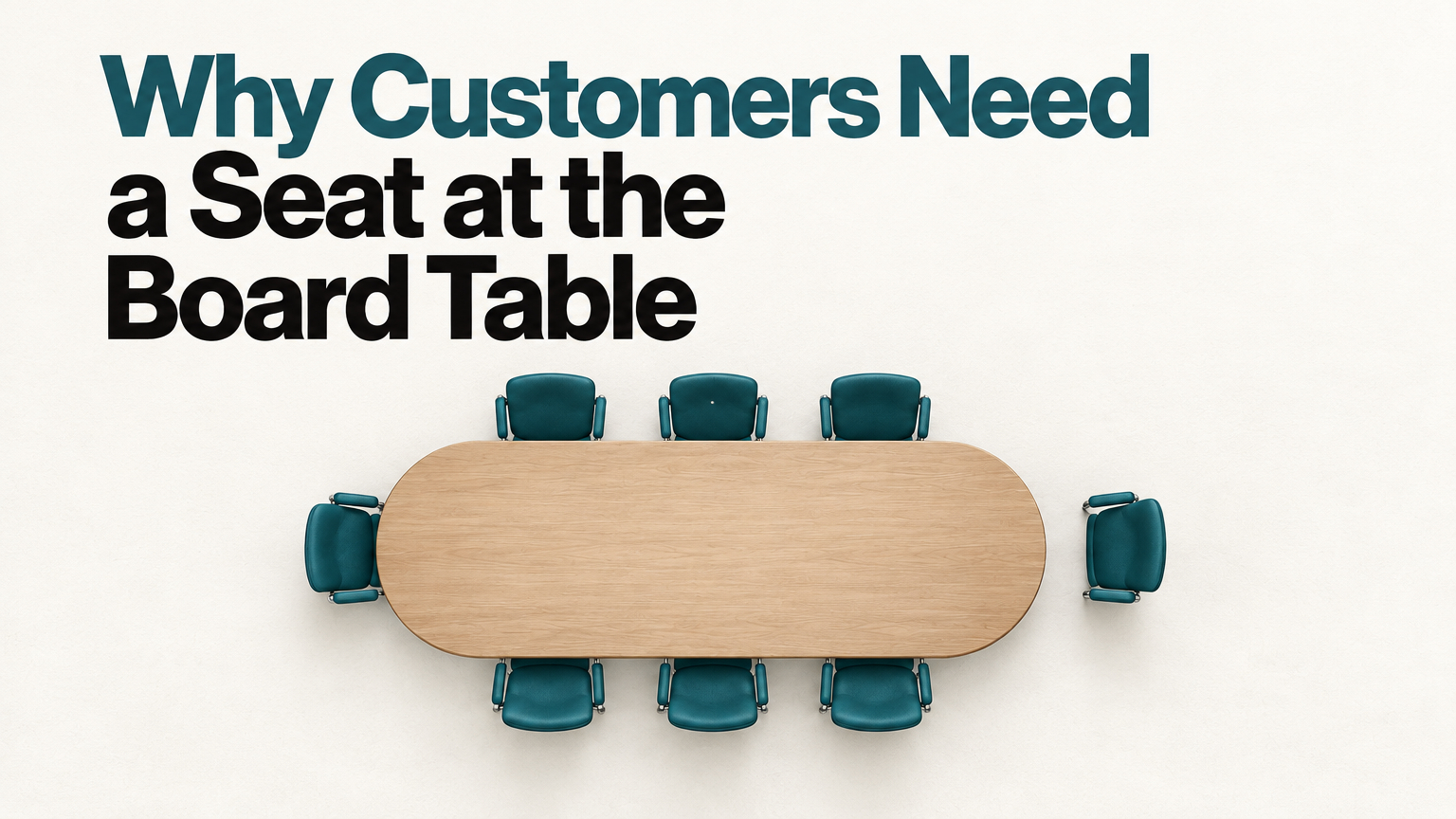
There’s a second experiment, borrowed from my systemic team coaching practice. We bring stakeholders into the room by adding an extra seat at the table for one of them, such as the customer. Then we ask a participant to volunteer to sit in it.
It still amazes me how much this shift in perspective unlocks. Things the team already knew start coming out. Try it at your next meeting.
The short version: One question and one extra chair can show a board, in a single meeting, how close its decisions really are to customers.
Why does this matter for long-term growth?
As I understand it, boards exist to protect the long-term interests of the organisation. I believe those interests depend mainly on its relationship with customers. Governance that ignores that relationship suggests a board guided by spreadsheets and slides rather than the real voices of its stakeholders.
My conviction is simple. The companies that grow steadily over decades are the ones where customer reality reaches the board table, unfiltered and on time.
Giving the customer a genuine seat at board level is, I think, one of the highest-return decisions a board can make, and it costs almost nothing to start.
Your next board meeting is the right moment to begin.
Key takeaways
-
Customer feedback reaches boards filtered, so the customer perspective often vanishes from board decisions.
-
That distance is structural, built into how boards receive information.
-
The costs are wasted effort, slower growth and misallocated capital, and they’re rarely traced back to the board.
-
Customers deserve the same weight at board level as finance or risk.
-
A standing agenda item, raw evidence, one accountable director and regular customer time cost almost nothing.
-
Start by asking “Which customer need does this address, and how do we know?” at your next meeting.
Bruno Vinel
Executive Coach and Team Coach, former CFO and executive
Frequently asked questions
What does it mean to give customers a seat at the board table?
It means giving the customer perspective the same weight in board discussions as finance or risk. In practice, that’s a standing agenda item, raw customer evidence and one director accountable for customer value.
Why do boards lose touch with customers?
Board members rely on summary reports. Customer feedback passes through two or three layers of management before it reaches them, and each layer removes friction, nuance and bad news.
What does a board disconnected from customers cost an organisation?
Wasted effort, slower growth and misallocated capital. These costs are rarely traced back to the board decision, so they often get blamed on execution, timing or the market.
Can the CEO or sales director represent the customer at board level?
In my view, no. One board director, or a chief customer officer contributing directly to board discussions, should own the customer perspective and have a mandate to challenge proposals.
What customer evidence should go into the board pack?
Raw, unedited material: recorded customer calls, word-for-word complaints and interviews with former customers.
Does this need new technology or a big budget?
No. It needs the board to decide that customer reality belongs in the room where capital is allocated.
What’s a quick test a board can run?
For every major decision, ask: “Which customer need does this address, and how do we know?” A specific, evidence-based answer is a healthy sign. A vague one suggests a disconnect.
What is the extra chair exercise?
It comes from systemic team coaching. You add a seat at the table for a stakeholder, such as the customer, and ask a participant to take it. That brings the customer perspective straight into the discussion.