
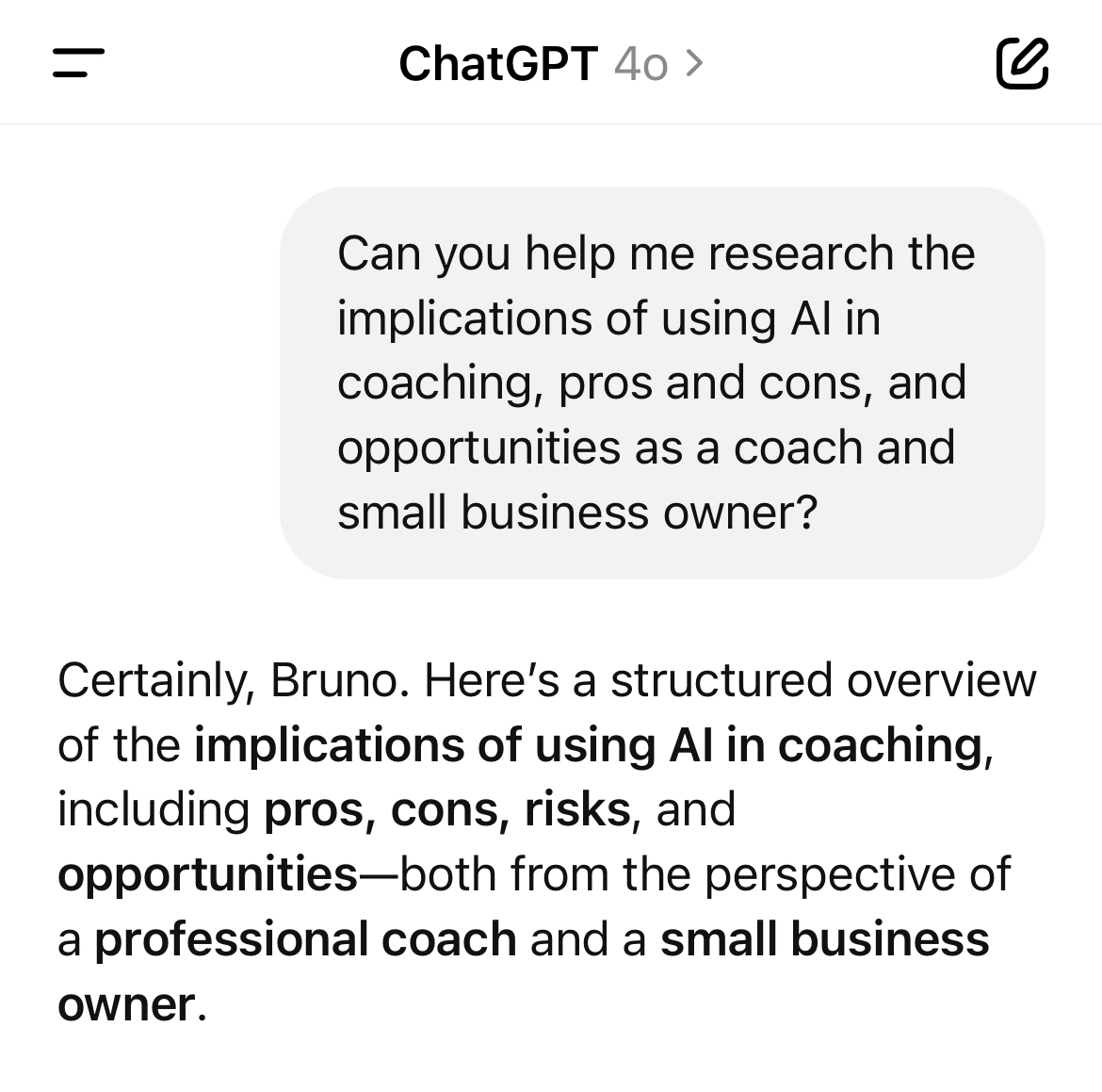
Following my attendance at a AI virtual coffee meeting organised by the Association for Coaching, I reflected back on how AI is changing my ways of working and its potential for amplifying my executive coaching business.
The rise of generative AI has triggered significant questions across many professions—including coaching. As an executive coach running a small business, I’ve often found myself both intrigued and cautious. Using AI to support my work presents both opportunities and challenges.
It’s no secret that major coaching platforms like BetterUp and CoachHub are investing heavily in AI. They are aiming at scaling up or even automate some parts of the coaching process. Understandably, this raises concerns. Will AI eventually replace what makes human coaching more effective, for example the human connection, trust, and deep listening that occur in real conversations?
However, ignoring this technology altogether would mean missing a tremendous opportunity—especially for small coaching practices like mine.
Over the past ten months, I’ve been experimenting with AI tools such as ChatGPT, Claude.ai, and Perplexity.ai. My goal was to see whether these tools could help me amplify my business, without compromising my values as a coach. Here’s what I learnt.

1. AI as a Marketing Assistant: Writing Content and Generating Leads
Creating thoughtful content as a coach takes time—especially when it’s personal. I wrote about my experience with cancer and how it reshaped my perspective on change, leadership, and resilience. And I turned to ChatGPT to help me draft my posts for LinkedIn.
The process was straightforward: I provided my outline and key messages in a prompt. ChatGPT helped me polish the structure, copywriting, and even suggest relevant SEO keywords. The results were impressive. The post gained meaningful engagement and visibility—and even generated coaching leads.
Without AI, each post might have taken me one or two full working days. With AI, I cut that time by more than half—freeing me to focus on client work and strategic development.
I also use the AI assistant in Mail on my Mac and Copilot in Word to write and proofread emails and proposals.
2. Using ChatGPT to Stay on Track with My Diet and Motivation
Earlier this year, I also tested how AI could help with personal accountability. As part of my health journey to reverse diabetes, I followed a strict low-calorie diet. In the past, I tracked every meal using spreadsheets which was time-consuming and exhausting. This time, I tried something simpler: I told ChatGPT what I had eaten each day (breakfast, lunch, dinner, and snacks), and it gave me a rough calorie estimate. ChatGPT doesn’t replace a proper nutrition app, and I couldn’t receive notifications. Therefore it was perfect but it helped me stay mindful and motivated, and it worked with minimal effort. And I even told ChatGPT when I was craving and it suggested approaches to maintain my diet!
This approach aligned perfectly with my coaching philosophy: simplify where possible to focus energy where it matters most.
3. Creating My Coaching Website with AI Support
Six months ago, I launched the first version of my executive coaching website using WordPress. It was a solo project, so I used ChatGPT, Claude.ai, and Perplexity.ai to assist with content research, page structure, and copywriting.
These tools helped me clarify the message, craft my unique value proposition, and ensure consistent tone and SEO integration across the site. I estimate I saved at least 50% of the time it would have taken if I had done everything manually.
But here’s a cautionary tale: whilst using one AI tool to help me draft a version of my homepage, I noticed that its suggestions felt rather too polished. Out of curiosity, I copied a few sentences and searched them on Google. What I discovered was revealing and not entirely surprising: some of the proposed content was a copy and paste of another coach’s website with similar positioning.
This experience taught me a valuable lesson: whilst generative AI can offer powerful support, we must fact-check, search, and validate for originality, especially when publishing client-facing material. Tools like these can sometimes draw inspiration from existing websites too literally, even unintentionally.
4. AI for Coaching Research and Resource Development
I’ve turned to ChatGPT and Perplexity.ai for assistance when deepening my skills or designing coaching programmes. This worked particularly well for instance on topics like values-based leadership, resilience, or transition in career or life.
Unlike a basic Google search, these tools can summarise articles, point to relevant frameworks and models, and provide examples to spark ideas. They also help reframe coaching questions. I’ve often saved more than 50% of the time I would normally spend gathering and summarising material.
That said, AI still has limitations. It can’t replace a good book on coaching. Also, AI insights tend to reflect mainstream sources. They sometimes miss newer studies, expert perspectives from specialist sources such as Forbes, Harvard Business School or research papers. GenAI is also known for ignoring minority voices that challenge the dominant view.
As a coach working across cultures and life experiences, I remain vigilant about this and always look to bring balance and nuance into my work.
5. AI for Transcribing and Summarising Coaching Calls and Meetings
I don’t take notes during coaching sessions but instead reflect afterwards and jot down points for supervision. In online non-coaching meetings, with agreement of the participants, I use the transcription features in Teams and Zoom. They produce transcripts, summaries of discussions and action items. These tools are time-saving and worth trying.
6. AskBill AI Business Coach for Coaches
The executive coach Mary Rafferty recommended me to try AskBill.us, so I sought AI advice for growing my coaching business. The bot asked few questions and suggesting integrating my passion for photography into my business to enhance lead generation and client engagement. It even mentioned potentially publishing a book. Whilst the 20-minute session was pleasant and inspiring, it did not match the value of working with a human coach. It also failed to answer my initial question: “What should I do more of or differently?”. Nevertheless, I recommend the experience, to discover the current state of AI coaching.

Looking Ahead: AI That Amplifies Human Coaching
GenAI and AI coaching bots currently remain some distance from fully replacing professional coaches. Based on my experience and feedback from other coaches, these GenAI “coaches” are far from demonstrating the full International Coaching Federation competencies (establishing agreements, cultivating trust, maintaining presence, active listening, evoking awareness, and facilitating client growth).
These technologies are progressing quickly and are expected to enhance the coaching experience. Coaching platforms have been presenting their AI coaching solutions to corporations, suggesting that these tools may play a larger role in Learning & Development. They argue that GenAi makes coaching more accessible to middle managers, particularly through cost reduction. Coaching accreditation bodies are working to define what constitutes coaching with GenAI. They are looking whether these platforms adhere to their ethical principles.
The future I’m most interested in is not one where AI replaces coaches—but one where it amplifies what human coaches do best. Imagine AI systems that:
- Support coaches in reaching their target audience, through supporting creating content, nurturing and converting leads, and bringing on board new clients
- Automate administrative tasks, scheduling sessions, and invoicing clients
- Engage clients between sessions with reflections and nudges
- Track client progress in real-time. Support their accountability through 24/7 availability, without replacing the coaching sessions themselves
- Help coaches evaluating the sessions in real-time and reflecting on them afterwards
- Support coaches in examining their practice, growing in confidence, and maintaining high ethical and professional standards
Currently, most CRM tools and marketing automation platforms (like Salesforce or HubSpot) are too complex and expensive for small coaching practices. I believe we will soon see a new wave of AI platforms built for coaches. They will not replace us, but strengthen our services and help our clients succeed.
Final Thoughts
I would like to quote Ethan Zuckerman who in a recent column in Prospect said “Investment in AI is following a classic—but deeply problematic—pattern of technological inevitability. Because a technological future of AI-enabled everything is possible, we jump to the conclusion that it is inevitable, failing to question whether or not it is desirable.”
There is ongoing discussion about whether AI will impact the role of human coaching. Coaches are required to organise and communicate their perspectives both with clients and through accreditation bodies. Collaboration among coaches can help companies and clients make informed decisions about the capabilities and limitations of generative AI compared to human coaching.
At the same time coaches will learn how to use AI ethically and strategically. They will find themselves better equipped to serve their clients, run their business, and free up time for what truly matters: human connection, trust, and transformation.
This signals the beginning of a new professional approach and constitutes an important milestone in my career trajectory. With nearly 38 years of experience I remember a time when telephone calls, letters and fax transmissions dominated communication. Today I welcome the integration of AI as a valuable means to significantly enhance my business development efforts.
Feedback and comments are welcomed for continuing the discussion.
Are You Embracing Change in Your Life or Business?
Are you curious about how AI could support your work? Or are you navigating a period of personal or professional change and looking for clarity, focus, and support? I’d be happy to help.
I offer executive coaching for leaders, professionals, and entrepreneurs facing transition, whether it’s building a business, returning to work after illness, or adapting to new challenges. This includes helping them and their teams embrace AI.